
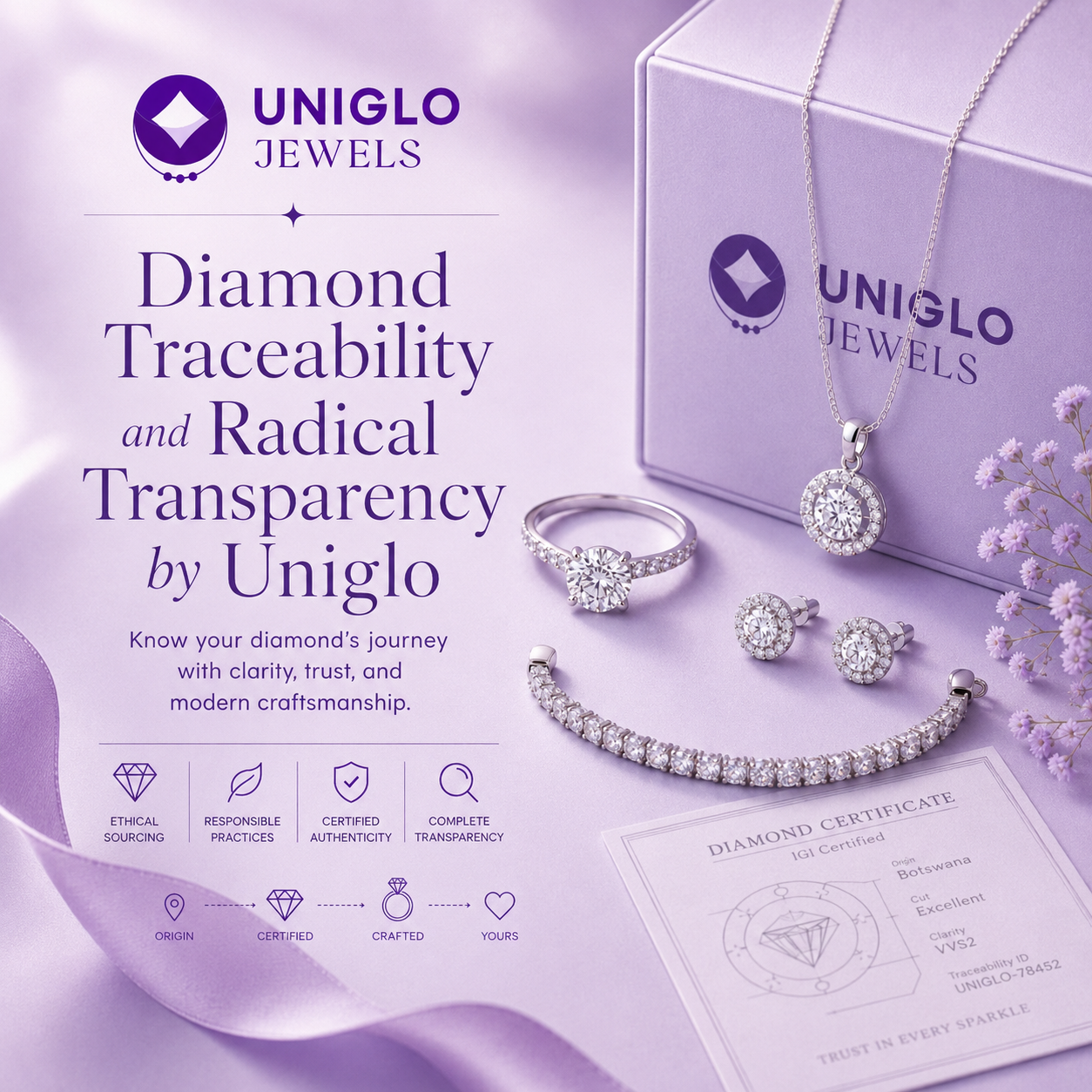
Radical Transparency in Diamond Buying
Radical transparency in diamonds means being able to understand the full journey of a diamond, from its origin to its final jewellery form. It goes beyond the basic 4Cs and gives buyers clearer information about where the diamond came from, how it was sourced or created, how it was cut, how it was certified, and whether it aligns with their values.
For natural diamonds, transparency helps explain their earth-formed origin, sourcing journey, and craftsmanship. For lab-grown diamonds, it helps buyers understand the technology, creation process, and quality standards behind the stone. In both cases, transparency builds trust.
At Uniglo, the future of diamond luxury is not only about brilliance. It is about clarity, traceability, responsibility, and helping buyers choose diamonds they can truly understand.
Quick FAQs
What is radical transparency in diamonds?
Radical transparency means giving clear, honest, and traceable information about a diamond’s origin, journey, certification, and craftsmanship.
Why does diamond traceability matter?
Traceability helps buyers understand where a diamond came from, how it was sourced or created, and whether it aligns with their values.
Can lab-grown diamonds be traced?
Yes. Lab-grown diamonds can often be traced through their production process, growth method, grading, and certification details.
Is certification the same as transparency?
No. Certification is important, but transparency includes a wider view of origin, process, ethics, sourcing, and communication.
How does Uniglo approach transparency?
Uniglo focuses on clarity, honest communication, certification, responsible practices, and helping buyers understand the diamond journey.
Luxury Is No Longer Only About What You See
For decades, diamonds have been sold as symbols of perfection.
People have admired their brilliance, celebrated them during life’s most meaningful moments, and trusted their value because diamonds have always carried a powerful emotional language. They have stood for love, permanence, achievement, beauty, and legacy.
But behind that sparkle, there has often been a quiet gap.
Many buyers knew the carat weight, colour, clarity, and cut, but not always the full journey of the diamond. Where did it begin? How was it sourced or created? Who handled it before it became jewellery? What processes shaped it into its final form? Was the story clear, or was it simply assumed?
Today, that gap is closing.
Modern luxury is no longer only about what a diamond looks like. It is also about what you know. Buyers want beauty, but they also want clarity. They want emotion, but they also want information. They want jewellery that feels special, but they also want confidence in the story behind it.
This is where radical transparency changes everything.
At Uniglo, transparency is not treated as an extra detail. It is part of how modern diamond trust is built.
Explore Uniglo diamonds and discover jewellery shaped by brilliance, traceability, craftsmanship, and clear information.
The Shift From Owning to Understanding
There was a time when buying a diamond felt simple.
A buyer would visit a jeweller, compare stones, review the 4Cs, choose a design, and make a decision based on beauty, price, and trust. That process still matters, but today’s buyer expects more.
People no longer want to own a diamond without understanding it.
They want to know where it came from. They want to understand whether it is natural or lab-grown. They want to know how it was formed or created. They want clarity about certification, craftsmanship, sourcing, and value.
This shift is changing the diamond industry.
A diamond is no longer judged only by what is visible under light. It is also judged by the information behind it. For many buyers, the story of the diamond is now part of the luxury experience.
This does not make diamond buying less emotional.
It makes it more meaningful.
When you understand the journey of a diamond, you do not reduce its romance. You deepen it. The stone becomes more than a beautiful object. It becomes something you can trust, explain, and connect with.
What Radical Transparency Really Means
Transparency means clarity.
Radical transparency goes further.
It means giving buyers a clear view of the diamond’s journey from beginning to final form. It means removing vague claims and replacing them with useful, verifiable information. It means showing the buyer what they are choosing instead of asking them to accept a story without detail.
In diamonds, radical transparency can include documented sourcing, origin details, traceable creation or production information, clear certification, honest communication about natural and lab-grown options, and openness around craftsmanship.
It is not only about saying a diamond is beautiful.
It is about explaining why it is beautiful, how it became beautiful, and what makes it trustworthy.
A transparent diamond experience gives the buyer confidence. It answers questions before confusion begins. It helps people choose with both emotion and intelligence.
At its best, radical transparency turns diamond buying from a mystery into a relationship built on trust.
Traditional Diamond Buying vs Transparent Diamond Buying
| Buying Experience | Traditional Approach | Transparent Approach |
|---|---|---|
| Origin | Often explained generally | Clearly identified and explained |
| Natural or lab-grown | Sometimes presented with limited detail | Explained honestly with origin differences |
| Certification | Used as a quality report | Used as part of a wider diamond story |
| Sourcing | May remain unclear | Shared with more openness where available |
| Craftsmanship | Often hidden behind the finished piece | Explained as part of the diamond’s journey |
| Buyer confidence | Based mainly on trust in the seller | Built through trust, information, and clarity |
| Emotional value | Based on beauty and occasion | Deepened by knowing the journey |
Transparency does not remove the beauty of diamonds. It gives that beauty more foundation.
Where Every Diamond’s Story Starts
Every diamond begins somewhere.
For natural diamonds, the story begins deep within the earth. They form under extreme heat and pressure over extraordinary periods of time. Their journey to the surface is shaped by geology, nature, and time. For many buyers, this origin gives natural diamonds a strong emotional quality. They feel rare, ancient, and connected to the earth.
For lab-grown diamonds, the story begins in a controlled environment. Advanced methods such as HPHT and CVD are used to create diamond crystal growth through technology. The result can be a diamond with the same essential diamond structure and optical beauty as a natural diamond, but with a different origin.
This is why transparency matters.
A buyer should know which origin they are choosing. Not because one story must be superior to the other, but because different origins carry different meanings.
Natural diamonds may speak to heritage, rarity, and earth-formed history.
Lab-grown diamonds may speak to innovation, precision, and modern choice.
Both can be beautiful.
Both can carry emotion.
But the buyer deserves to understand the difference clearly.
From Origin to Cutting: The Invisible Journey
Once a diamond is sourced or created, its journey is far from complete.
Before it becomes jewellery, it passes through important stages of evaluation and transformation. The rough stone is studied. Its structure is examined. Experts decide how it should be cut to bring out its best beauty. The diamond is shaped, faceted, polished, checked, graded, and eventually set into jewellery.
Much of this journey traditionally happened behind the scenes.
The buyer would see the final diamond, but not always the decisions that made it possible. Yet those decisions matter deeply. A diamond’s final brilliance depends on planning, cutting, polish, symmetry, proportion, and craftsmanship.
Radical transparency brings these hidden stages closer to the buyer.
It helps people understand that brilliance is not accidental. A beautiful diamond is not only the result of origin. It is the result of careful decisions made at every stage.
At Uniglo, the finished diamond matters, but so does the journey that leads to it. The brilliance you see is only possible because of the precision you do not always see.
The Diamond Journey at a Glance
| Stage | What Happens | Why It Matters |
|---|---|---|
| Origin | The diamond is formed naturally or created in a lab | Defines the beginning of the diamond’s story |
| Sourcing or creation | The diamond enters the supply or production process | Helps establish traceability and responsibility |
| Rough evaluation | The stone is studied for structure and potential | Determines the best way to reveal beauty |
| Cut planning | Experts decide the ideal shape and proportions | Impacts brilliance, weight, and final value |
| Cutting and polishing | Facets are shaped and surfaces refined | Creates light performance and visual beauty |
| Quality review | The diamond is checked for performance and finish | Ensures standards are met |
| Certification | The diamond is graded and documented | Builds buyer confidence |
| Jewellery setting | The diamond is placed into a final design | Turns the stone into something wearable and meaningful |
A transparent diamond experience helps buyers see these stages not as technical details, but as part of the diamond’s identity.
Certification Is Important, But It Is Not the Whole Story
Certification has always played an important role in diamond buying.
A certificate or grading report gives useful information about the diamond’s cut, colour, clarity, carat weight, measurements, and other characteristics. It helps buyers compare stones and understand quality more clearly.
But certification is not the same as full transparency.
A certificate can tell you what a diamond is, but it may not tell you everything about its journey. It may describe the diamond’s characteristics, but transparency also asks broader questions. Where did the diamond begin? How was it sourced or created? What processes shaped it? How clearly is the seller communicating?
In a transparent diamond experience, certification becomes part of a larger story.
It supports the facts, but it does not replace honest communication. It gives structure, but it should be connected to origin, craftsmanship, and buyer education.
At Uniglo, certification is respected, but it is not treated as the only point of trust. True confidence comes from combining documentation with clarity.
Why Transparency Is Becoming Non-Negotiable
The modern buyer is more informed than ever.
People have access to information. They compare brands. They ask about ethics, sustainability, sourcing, production, certification, and value. They do not want to be pressured into a purchase without understanding what they are buying.
This is especially important in diamonds because the purchase is often emotional and significant.
Buyers want to know whether a diamond was responsibly sourced. They want to understand how a lab-grown diamond was created. They want to know if there are hidden details that affect value or meaning. They want to feel that the brand is answering questions clearly, not avoiding them.
These questions are valid.
Luxury today is no longer only about exclusivity.
It is also about responsibility.
Radical transparency allows brands to answer with confidence instead of ambiguity. It makes the buying experience more respectful, more informed, and more aligned with modern expectations.
The Emotional Value of Knowing
Something changes when you understand your diamond’s journey.
The diamond becomes more personal.
When you know where it came from, how it was formed or created, how it was shaped, and why it looks the way it does, the piece begins to carry more than visual beauty. It carries knowledge. It carries intention.
This emotional value can be powerful.
A natural diamond may feel more meaningful when you understand its earth-formed origin and the craft that revealed its brilliance. A lab-grown diamond may feel more meaningful when you understand the technology, precision, and modern choice behind it.
Knowing does not make the diamond less magical.
It makes the magic clearer.
A diamond chosen with understanding feels different from a diamond chosen blindly. It becomes something you can explain, remember, and trust.
That trust adds emotional weight.
Redefining Trust in the Diamond Industry
For many years, trust in diamonds was built mainly on reputation.
People trusted a jeweller, a brand name, a family recommendation, or a certificate. These things still matter, but trust today is being rebuilt on deeper transparency.
Modern buyers do not only want to be told that a diamond is good.
They want to be shown why.
This is an important shift.
At Uniglo, the philosophy is simple: clarity creates confidence. When buyers can understand a diamond’s origin, quality, certification, and craftsmanship, they feel more secure in their decision.
Nothing should feel hidden. Every important detail should be communicated clearly.
Trust grows strongest when there is less uncertainty.
This is why transparency is not just a technical standard. It is an emotional promise between the brand and the buyer.
Natural vs Lab-Grown: Transparency Changes the Conversation
The conversation around natural and lab-grown diamonds often becomes too focused on comparison.
Which is better?
Which is more valuable?
Which should someone choose?
Transparency changes the conversation.
When both types of diamonds are clearly explained, the buyer can make a decision based on preference instead of confusion. Natural diamonds and lab-grown diamonds have different origins, different market behaviours, and different emotional associations.
A natural diamond may appeal to someone who values rarity, tradition, and natural formation.
A lab-grown diamond may appeal to someone who values innovation, design flexibility, and modern accessibility.
The point is not to push one over the other.
The point is to explain both honestly.
When buyers understand the difference, they can choose based on personal values, budget, design preference, and emotional connection.
That is the power of transparency.
It turns comparison into clarity.
The Future of Diamonds Is Fully Visible
The diamond industry is moving toward greater openness.
Buyers will continue to expect more information, not less. Traceability, ethical practices, clear origin details, certification, and customer education will become more important as diamond buying evolves.
Opacity is no longer acceptable.
The future belongs to brands that share information openly, explain choices clearly, embrace traceability where possible, and treat buyers as informed partners rather than passive customers.
This is not just a trend.
It is a permanent shift in luxury.
The next generation of diamond buyers will not be satisfied with beauty alone. They will want beauty supported by truth. They will want jewellery that feels emotionally meaningful and responsibly explained.
That is where Uniglo’s approach fits naturally.
The diamond should shine, but the story should be clear.
A Diamond You Can Truly Know
Radical transparency is ultimately about empowerment.
It gives buyers the ability to make informed decisions. It helps them move beyond surface beauty and understand the substance behind the diamond. It gives them confidence not only in what they are buying, but in why they are buying it.
A diamond you can truly know feels different.
You understand its origin. You understand its quality. You understand its journey. You understand why it has been selected, shaped, and presented.
This does not remove emotion from the buying process.
It strengthens it.
Because when you finally choose the diamond, you are not only choosing something that shines. You are choosing something you understand.
Final Thought: Truth You Can Wear
What if you could trace your diamond back to its beginning?
That question is no longer only an idea. It is becoming part of the future of diamond luxury.
Diamonds are not defined by brilliance alone. They are defined by their journey, their craftsmanship, their origin, their certification, and the trust behind them.
When that journey is fully revealed, the diamond becomes more than a luxury object.
It becomes truth you can wear.
At Uniglo, this is the future of diamonds: beautiful, traceable, meaningful, and clear.
Because true brilliance should never need mystery to feel valuable.
It should shine even brighter when the story is known.
Discover Transparent Diamond Luxury at Uniglo
Explore diamonds selected with clarity, craftsmanship, and meaning. Whether you are choosing natural diamonds or lab-grown diamonds, Uniglo helps you understand origin, quality, certification, and the journey behind your jewellery.
Discover Uniglo diamonds and choose brilliance you can trust, understand, and wear with confidence.
FAQs
What is radical transparency in diamonds?
Radical transparency means giving buyers clear and honest information about a diamond’s origin, sourcing or creation process, certification, craftsmanship, and journey before it becomes jewellery.
Why is diamond traceability important?
Diamond traceability helps buyers understand where a diamond came from, how it was sourced or created, and whether it aligns with their values.
Is certification enough when buying a diamond?
Certification is important, but it is not the full story. Transparency also includes origin, process, sourcing, craftsmanship, and honest communication.
Can natural diamonds be traced?
Natural diamonds can often be supported by sourcing information, certification, and documentation, though the level of traceability can vary depending on the supply chain.
Can lab-grown diamonds be traced?
Yes. Lab-grown diamonds can often be traced through their production method, growth process, grading, and certification details.
What is the difference between diamond origin and diamond certification?
Origin explains where and how the diamond began. Certification describes the diamond’s quality characteristics, such as cut, colour, clarity, and carat.
Why do modern buyers care about transparency?
Modern buyers want to make informed decisions. They care about ethics, origin, value, sustainability, craftsmanship, and whether the diamond aligns with their personal values.
Does transparency make a diamond more meaningful?
Yes. Understanding a diamond’s journey can create a deeper emotional connection and make the jewellery feel more personal and intentional.
How does transparency affect natural vs lab-grown diamonds?
Transparency helps buyers understand the real difference between natural and lab-grown diamonds, allowing them to choose based on preference, values, budget, and meaning.
Why choose Uniglo for transparent diamond jewellery?
Uniglo focuses on clarity, certification, craftsmanship, responsible practices, and honest communication, helping buyers choose diamonds with confidence and understanding.