
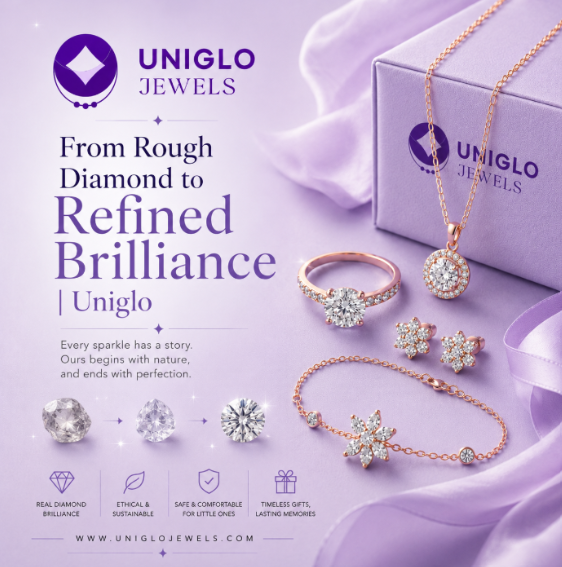
Quick Summary
A diamond does not begin as the polished, brilliant stone we see in fine jewellery. It begins as potential. In its rough form, a diamond can look quiet, uneven, and unfinished. Its true beauty is revealed only through careful study, expert cutting, precise polishing, and thoughtful craftsmanship.
At Uniglo, the journey from rough stone to refined brilliance is treated with patience and respect. Every diamond is studied for its structure, natural character, light performance, and best possible shape. The goal is not to force a diamond into a standard idea of perfection. The goal is to reveal the beauty already hidden inside it.
Whether natural or lab-grown, every diamond carries a journey. What makes it exceptional is not only how it shines at the end, but how carefully it becomes what it was meant to be.
Discover how every diamond's journey ends with timeless brilliance.
Before Brilliance, There Is Becoming
There is a quiet kind of transformation that does not happen all at once.
It happens slowly, through attention, patience, and skill. Something that may look ordinary at first begins to reveal depth. What once seemed unfinished starts to take form. With every careful decision, it becomes clearer, brighter, and more powerful.
This is the journey of a diamond.
Before a diamond becomes a ring, pendant, bracelet, or pair of earrings, it begins as a rough stone. At that stage, it does not yet show the sparkle people associate with fine jewellery. It may look uneven, cloudy, irregular, or simple to the untrained eye.
But within that rough stone is possibility.
At Uniglo, this beginning is never rushed or overlooked. The rough diamond is studied with care because its final beauty depends on understanding what it can become. Every internal line, every inclusion, every natural shape, and every small detail matters.
A diamond is not simply made beautiful.
It is revealed.
Explore Uniglo diamonds and discover brilliance shaped by patience, precision, and meaningful craftsmanship.
Where the Diamond Journey Begins
A diamond’s journey begins long before it reaches a jewellery setting.
Natural diamonds are formed deep within the earth through intense heat and pressure over a very long period of time. Lab-grown diamonds are created through advanced technology that allows carbon to crystallise into diamond under controlled conditions. Their origins are different, but both begin with the same essential element: carbon arranged into a diamond structure.
In the beginning, neither natural nor lab-grown diamonds look like finished jewellery.
They must be studied, shaped, and refined.
This first stage is one of the most important parts of the process. A rough diamond holds information inside it. Its structure tells experts what kind of shape may suit it best. Its internal characteristics help determine how it should be cut. Its natural form gives clues about how to preserve beauty, maximise brilliance, and reduce unnecessary loss.
At Uniglo, this stage is treated with great care. The stone is not seen only for what it is in the present. It is seen for what it could become.
That understanding is where true craftsmanship begins.
Understanding the Rough Stone
To most people, a rough diamond may not look impressive at first.
It does not have the sharp sparkle of a finished diamond. It does not yet show the clean reflections, symmetry, or polish that make a diamond feel alive with light. But to a trained eye, the rough stone is full of information.
The shape of the rough diamond can suggest whether it may become a round, oval, emerald, cushion, pear, or another cut. Its inclusions can help determine the safest and most beautiful way to shape it. Its internal growth patterns can affect how light will move through it once it is cut.
This is why diamond planning is so important.
A wrong decision early in the process can affect the diamond’s final beauty. A thoughtful decision can reveal brilliance that might otherwise remain hidden.
At Uniglo, the rough stone is studied before it is transformed. The goal is to understand the diamond’s natural strengths and work with them, not against them.
This is what makes diamond craftsmanship feel almost personal.
Every stone asks for a different approach.
The First Big Decision: Choosing the Cut
Transforming a rough diamond into a finished stone begins with one major decision: how should it be cut?
This decision changes everything.
A round brilliant cut may be chosen to maximise sparkle and classic beauty. An emerald cut may be chosen when the stone has clarity and structure that can support long, clean facets. A cushion cut may soften the diamond and bring warmth to its shape. An oval cut may create elegance, length, and graceful movement. A pear or marquise cut may bring drama and individuality.
The cut does not only affect the shape of the diamond. It affects the entire personality of the stone.
At Uniglo, this decision is never made carelessly. The cut must suit the diamond’s structure, but it must also suit the feeling the finished stone can carry. Some diamonds are meant to feel bold. Some are meant to feel soft. Some are meant to feel architectural, romantic, classic, or unusual.
The best cut is not always the most obvious one.
It is the one that brings out the diamond’s strongest beauty.
Diamond Cuts and Their Personality
| Diamond Cut | What It Often Expresses | Why It May Be Chosen |
|---|---|---|
| Round brilliant | Classic brilliance and timeless sparkle | To maximise light performance and traditional beauty |
| Oval | Grace, length, and softness | To create an elegant and flattering look |
| Emerald | Structure, clarity, and refinement | To highlight clean lines and quiet sophistication |
| Cushion | Warmth, romance, and softness | To create a gentle, vintage-inspired glow |
| Pear | Movement, individuality, and elegance | To combine softness with a distinctive point |
| Marquise | Drama, length, and presence | To create a bold and elongated look |
| Heart | Emotion, romance, and symbolism | To make love visible through shape |
| Radiant | Fire, strength, and modern sparkle | To combine bold shape with brilliant faceting |
A diamond’s cut gives it character. That is why the decision must be thoughtful. The cut should not only use the stone efficiently. It should also help the diamond feel complete.
Precision as a Form of Art
Once the cut is chosen, the work becomes highly precise.
Angles must be calculated carefully. Facets must be placed with balance. Symmetry must be refined. The polish must be clean enough to allow light to move beautifully across the surface.
This part of the process is technical, but it is also artistic.
A diamond’s brilliance depends on how light enters the stone, reflects inside it, and returns to the eye. If the angles are not right, the diamond may lose light and appear dull. If the proportions are well handled, the diamond can feel bright, lively, and full of movement.
But numbers alone do not create beauty.
Two diamonds can follow similar cutting plans and still feel different. One may look flat. Another may come alive. One may reflect light sharply. Another may glow with more softness. This is where expert judgment matters.
At Uniglo, precision is not used to make every diamond look identical. It is used to bring each diamond closer to its best expression.
The goal is not just sparkle.
The goal is presence.
Why Certification Is Only the Beginning
Certification is important in the diamond world.
It gives buyers useful information about a diamond’s cut, colour, clarity, carat weight, and other quality details. These details create a shared language and help build trust.
But certification is not the full experience of a diamond.
Two diamonds can have similar grading and still feel very different when seen in real life. One may look more balanced. Another may appear brighter. One may feel warmer, softer, or more elegant. Another may not create the same emotional response, even if the technical details look strong on paper.
This is why Uniglo looks beyond certification.
A diamond must be evaluated for how it performs in real light, how it moves, how it sits in a design, and how it feels to the person choosing it. Technical grading matters, but the final decision should also include the eye, the hand, and the heart.
A diamond is not chosen by numbers alone.
It is chosen by experience.
The Beauty of Character
For a long time, diamonds were often discussed through the idea of perfection.
The fewer inclusions, the higher the clarity. The whiter the colour, the more desirable the stone was assumed to be. The larger the carat, the more impressive the diamond seemed.
These details still matter, but modern buyers are beginning to understand something more personal.
Character matters too.
A slightly warmer tone can make a diamond feel softer and more romantic. A unique internal feature can make one stone feel different from another. A shape that is not the most common can feel more connected to the wearer’s personality.
This does not mean quality becomes less important. It means beauty is not only about uniformity.
At Uniglo, each diamond is considered for its individual nature. Some stones are exceptional because of their perfect symmetry. Others are memorable because they carry a softer, more distinct personality.
The right diamond is not always the one that looks most perfect on paper.
It is the one that feels most meaningful in person.
Natural and Lab-Grown Diamonds: Different Origins, Same Care
The journey from rough to refined can apply to both natural and lab-grown diamonds.
Natural diamonds carry the story of the earth. They are formed deep below the surface over immense time and shaped by nature before they are discovered and refined. Their appeal often comes from rarity, history, and the romance of natural origin.
Lab-grown diamonds carry the story of modern innovation. They are created through advanced technology and then cut, polished, and set with the same attention to beauty and performance. Their appeal often comes from precision, contemporary values, and design flexibility.
At Uniglo, both origins are treated with care.
A natural diamond should be understood, selected, and refined thoughtfully. A lab-grown diamond deserves the same level of attention. The origin may be different, but the responsibility of craftsmanship remains the same.
Every diamond must be studied.
Every diamond must be shaped with intention.
Every diamond must earn its final brilliance.
From Craftsmanship to Connection
The journey of a diamond does not truly end when the cutting and polishing are complete.
Its final purpose begins when it is chosen.
This is the most human part of the process. A person sees a diamond, and something connects. The stone may have the right shape, the right light, the right balance, or simply the right feeling. It may match a memory, a proposal, a gift, a milestone, or a personal chapter.
This moment cannot be fully predicted by grading reports or measurements.
It happens when craftsmanship meets emotion.
At Uniglo, diamonds are curated with this connection in mind. The goal is not only to offer stones that meet technical standards. The goal is to offer diamonds that feel meaningful to the person who will wear them.
A diamond becomes powerful when it stops feeling like an object and starts feeling personal.
That is the moment brilliance becomes memory.
A Quiet Evolution in Luxury
Luxury is changing.
It is no longer defined only by size, excess, or flawless display. Today, luxury is more thoughtful. It is about choosing something that feels aligned with who you are. It is about quality, intention, and emotional value.
This is why the journey from rough stone to refined diamond feels so relevant today.
It reflects patience. It reflects understanding. It reflects the belief that true beauty does not always need to be forced or rushed. Sometimes, the most powerful transformation is the one that happens with care.
At Uniglo, this philosophy shapes the way diamonds are selected and refined. A stone is not treated as a blank object to control. It is treated as potential to reveal.
That is a more modern and more meaningful way to understand brilliance.
The Final Form: Brilliance With Identity
By the time a diamond reaches its final form, it is no longer only a product of its origin.
It is the result of every decision made along the way.
How it was studied.
How it was planned.
How it was cut.
How it was polished.
How it was set.
How it is finally experienced.
Each step leaves its mark on the finished diamond. This is why the process matters so much. A diamond’s beauty is not created in one moment. It is built through a series of careful choices.
At Uniglo, that journey is respected. The brand understands that a diamond is not simply created. It is revealed through patience, knowledge, and craftsmanship.
The final diamond should feel refined, but not empty. Brilliant, but not generic. Beautiful, but also full of identity.
From Rough to Refined: The Uniglo Approach
| Stage | What Happens | Why It Matters |
|---|---|---|
| Rough evaluation | The diamond’s structure, shape, and internal features are studied | Helps determine the best possible outcome |
| Cut planning | Experts decide which diamond shape will suit the stone | Impacts beauty, value, and light performance |
| Cutting | The rough stone is shaped into its planned form | Begins revealing the diamond’s identity |
| Faceting | Facets are placed to control light movement | Creates sparkle, fire, and visual balance |
| Polishing | Surfaces are refined for clarity and finish | Enhances brilliance and smoothness |
| Quality review | The finished diamond is checked for performance and appearance | Ensures it meets high standards |
| Jewellery setting | The diamond is placed into a final design | Turns the stone into a wearable memory |
This journey shows why diamonds cannot be rushed. Every stage matters. Every decision shapes the final experience.
Final Thought: The Art of Becoming
What makes a diamond truly exceptional is not only how it shines.
It is how it becomes.
From a rough and quiet beginning, a diamond passes through study, planning, cutting, polishing, and design. It is shaped by nature or science, then refined by human skill. It becomes more than a stone because every stage reveals something hidden inside it.
This transformation is powerful because it mirrors something deeply human.
We also become slowly. Through pressure, patience, change, and careful choices, we become clearer versions of ourselves. Perhaps that is why diamonds feel so meaningful. Their brilliance is not immediate. It is earned, revealed, and refined.
At Uniglo, this journey is honored from the very beginning.
Because before brilliance, there is becoming.
And when that becoming is handled with care, the result is unforgettable.
Discover Refined Diamond Brilliance at Uniglo
Explore diamonds shaped by precision, patience, and thoughtful craftsmanship. Whether you are drawn to natural diamonds, lab-grown diamonds, classic cuts, or unique shapes, Uniglo helps you find a diamond that feels beautifully refined and personally meaningful.
Discover Uniglo diamonds and experience the journey from rough stone to refined brilliance.
FAQs
What is a rough diamond?
A rough diamond is a diamond before it has been cut, polished, and shaped into a finished gemstone. It may look irregular or unpolished, but it holds the potential for brilliance.
How does a rough diamond become a polished diamond?
A rough diamond becomes polished through planning, cutting, faceting, polishing, and quality review. Each step helps reveal the diamond’s shape, sparkle, and beauty.
Why is diamond cutting so important?
Diamond cutting is important because it controls how light moves through the stone. A well-cut diamond can appear brighter, more balanced, and more brilliant.
Are natural and lab-grown diamonds cut the same way?
Both natural and lab-grown diamonds can be cut and polished using the same principles of craftsmanship. Their origins differ, but both require skill to reveal their brilliance.
What determines the best cut for a rough diamond?
The best cut depends on the rough diamond’s shape, structure, inclusions, size, and potential light performance. Experts study the stone before deciding how to cut it.
Is certification enough when choosing a diamond?
Certification is important, but it is not everything. A diamond should also be evaluated for how it looks in real light, how it feels, and how well it suits the final jewellery design.
Can imperfections make a diamond unique?
Yes. Some natural features, warmer tones, or subtle characteristics can give a diamond personality. Quality still matters, but individuality can also add emotional value.
What makes a diamond feel special?
A diamond feels special when its beauty, craftsmanship, shape, and emotional meaning connect with the person choosing it.
Does Uniglo offer both natural and lab-grown diamonds?
Yes. Uniglo works with both natural and lab-grown diamonds, offering choices that reflect different origins, values, and personal preferences.
Why choose Uniglo for refined diamonds?
Uniglo focuses on precision, selection, craftsmanship, and emotional connection, helping buyers find diamonds that feel beautiful, meaningful, and lasting.